A New Zealand consultancy
We build the few systems that stop the business running on you.
Done-for-you AI systems for New Zealand owner-operators. A few things, built right, so the admin stops eating your week.
Book a 15-minute callFifteen minutes by phone. No deck, no pitch, no homework. We'll figure out what's costing you the most. If we can't help, we'll say so.
If this sounds like you
The work keeps coming. The team is good. The jobs get done.
But the admin has crept in around the edges of every week. Quotes go out late or not at all. Invoicing gets pushed to Sunday night, or the weekend after that. Some weeks you're at your desk past nine because nothing else moves until you handle it.
The reports say there's a business here. Some weeks, the bank account doesn't agree. Pricing sits in your head, not in a system. Everything that surrounds the actual work, quoting, follow-ups, customer comms, billing, flows through you, and only you.
You've heard about AI. You've maybe tried a couple of tools. None of it stuck because none of it was built for the way you actually work, whether that's on the tools with your phone in one hand, or between client meetings with forty unread emails.
You don't need another tool. You don't need to learn AI. You need a small number of systems that handle the work you most resent, built around how the business already runs.
We simplify the complexity of AI and integrate it into your business, creating tools you can actually use. We focus on the problems with the greatest return: the work the owner most resents, handled.
Quoting. Invoicing. Follow-ups. Customer communication. Billing that actually goes out. We work remotely with businesses across New Zealand. If you're in Wellington, Kāpiti, Manawatū, or Nelson, we can come to you.
The Methodology
Foundation before automation. Three phases, in order.
Most AI projects fall over because the business underneath isn't ready. The tool gets blamed. The real problem was further back.
01 / Foundation
Get the business out of people's heads.
Before any tool is installed, we map how the business actually runs. How jobs move, how quotes get built, how the team communicates. We interview the owner, work through whatever they've got, and turn what lives in their head into structured documents.
The outputs of this phase are valuable on their own. Process maps, written procedures, a real knowledge base. You can train new staff from them. Run the business from them. And they become the foundation that everything else builds on.
Foundation doesn't end with paperwork. The first system from your Performance Plan is built in this phase too. The one with the biggest return, configured on your processes and your pricing, installed and delivering a result. Not a generic chatbot. A working assistant that knows how your business runs. You leave the first month with documents you can run the business from, and a win you can measure.
Typical duration: Weeks 1–4
02 / Activation
Deploy AI against the foundation you've built.
With the foundation in place and the first system running, we work through the rest of your Performance Plan in priority order. Drafting quotes, replying to common customer questions, writing follow-up messages, generating job briefing notes. Whatever your plan says matters next. Each system is loaded with your processes, your pricing, your customer language, your supplier list.
A task that used to take forty minutes takes five. The draft is there. You read it, adjust if needed, and send. You review every output before it goes anywhere. The owner stays in control.
Typical duration: Weeks 4–8
03 / Integration
Connect the systems and let the routine work run.
Once the systems are bedded in and you trust the way they operate, we connect everything we've built to the tools your business already uses, and to each other. Accounting, job management, email, calendar. We build the workflows that take the repetitive multi-step tasks off your plate. Sometimes the systems we install do work that another tool was already doing. That's a call you make later, with better information than you had before. We don't push you to drop anything. We just stop hiding what's actually earning its keep.
A quote accepted in the morning generates the job checklist by lunchtime. A job completed on Friday becomes an invoice and a follow-up on Monday. Nothing autonomous. Nothing you can't see.
Ongoing, once Phases 1 and 2 are bedded in
How It Starts
Four steps. The first one's fifteen minutes.
Most consultancies want a half-day of your time before you know whether they're any good. We don't work like that. The first step is fifteen minutes on the phone, and its only job is to work out whether what you're dealing with is something we can help fix.
If it is, the next step is your Business Performance Plan. One to two hours by phone or video, walking through how the business runs and where time and money are leaking. You get a written action plan of what we would install, in priority order. It's free, and it's yours to keep. Work with us, or take the plan and do it yourself.
If you decide to move forward, we send you a short pre-work bundle. The invoices, pricing, and documents that matter for the specific build we're doing. You collate it in your own time. It usually takes an hour or two, spread across whenever suits.
Then the first build: your business context document plus the first win from the plan. One working system, installed and delivering a result. Remote as standard, on-site if you're in Wellington, Kāpiti, Manawatū, or Nelson. Pricing is fixed and in writing before anything starts.
The four steps
- 01
Fifteen-minute call. Free. Phone. We work out whether we can help. If we can't, we'll say so.
- 02
Business Performance Plan. One to two hours by phone or video. Free. A written action plan, yours to keep.
- 03
Pre-work bundle. The invoices, pricing, and documents we need for your specific build, collated in your own time.
- 04
The first build. One working system delivering a result, plus the foundation everything else builds on. Then you decide what's next, phase by phase.
We'll call you back within one working day. If we're not the right fit, we'll tell you on the call.
Who it's for
This isn't for everyone, and that's the point.
It's for you if:
You run an established New Zealand business, anywhere from a handful of staff to twenty or so. You've been operating for years and the work keeps coming. You are not short of work. You are short of hours in the day.
You are the owner or the person who runs the place day to day, and the business runs because you show up. Admin happens at night or it gets pushed.
You've heard about AI but the noise is overwhelming. You don't want a tour of twelve tools. You want someone to build the few things that matter, properly, and let you get back to work.
The sector matters less than the pattern. Trades, agribusiness, signage, light industrial, service firms, accounting practices, advisory businesses. A fee-earner rebuilding timesheets at the end of every billing cycle is the same problem as a tradie doing invoices on Sunday night. A high-value person, spending hours on work that shouldn't need them.
You can be anywhere in Aotearoa. We deliver remote as standard. If you're in Wellington, Kāpiti, Manawatū, or Nelson, on-site is an option.
It's not for you if:
You're a solo operator without staff. The returns from done-for-you usually aren't there yet. The workshop is built for you, though. Start there.
What you actually want is a templates library or an online community. We are not that. Everything we do is built on your specific business, with you or for you.
You've already decided AI is hype. We're built for the curious, and we're honest about what AI can't do. If your mind is made up, we won't spend fifteen minutes trying to change it.
You'd rather figure it out entirely alone. There are good free resources for that. We exist for people who don't have months to spare.
You're a large organisation with an in-house technology team. You need different help than we provide. We're built for owner-operators, not for organisations with their own IT function.
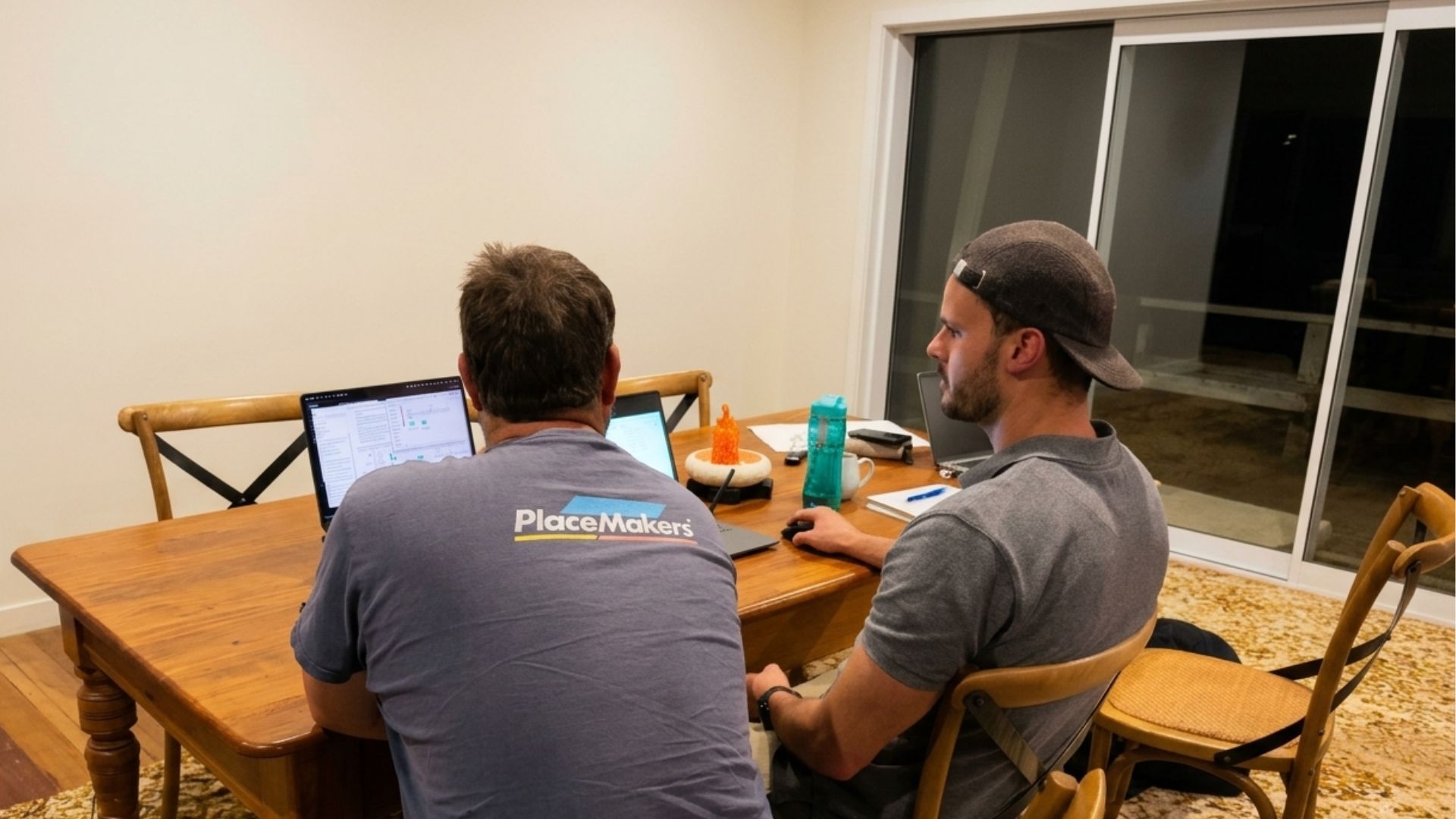
What it looks like installed
Three hours fifteen minutes to quote a hard job. Forty-five minutes with the system built for it.
A New Zealand signage business. Quoting was the bottleneck: every job priced from scratch, the hardest ones eating half a day. We mapped how the owner actually prices work, built that knowledge into a working assistant, and timed it on a live job.
One of the hardest jobs on the books: 3 hours 15 minutes to quote manually. 45 minutes through the system. The owner's own assessment across the board since: quoting now takes about a third of the time it used to.
The pattern repeats. A fencing contractor who planned an hour for every quote now produces one in a timed 25 minutes, through a system loaded with his own pricing and site process. The same engagement took the business from no systems at all to full data capture, from site visit notes and crew logs through variation costs and back-costing to invoice creation.
The methodology adapts to the business. The figures change. The work the owner most resents is what gets handled first.
The Business Performance Workshop
Not ready for done-for-you? Start in a room with us.
The Business Performance Workshop is a full-day, hands-on session for owner-operators who suspect AI could take real weight off them but can't see where it fits. Most AI workshops start with the tools. Ours starts with your business.
Small group, laptops open. You map where your business leaks time and money, then build AI on one of your own real problems, in the room, on the day. You walk out with a working assistant you built yourself, a map of where your hours actually go, and a straight answer on what's safe to put into AI tools and what isn't.
No technical knowledge needed. Built for the curious, not the convinced-against.
We run these across regional New Zealand. To hear about the next one near you, use the callback form and mention the workshop.

A Note From The Founders
I've spent my career building performance systems. The first decade was on the internal tools. Working with professional athletes and high-output operators on the habits, focus, and routines that hold up when the week goes sideways. Same operator, same philosophy. Now I build the external ones. The systems around a business, so the business stops running on the person.
The approach has worked for hundreds of people over the last decade. Find the biggest constraints. Back the few things that actually change the numbers. Make them simple enough that they run on autopilot, so you can put your attention where it actually counts.
What's changed in the last two years is that AI now does the heavy lifting on the work nobody enjoys. Drafting, summarising, chasing, capturing. The principles are the same. The scale is bigger. Most owners don't need to learn it. They need someone who has.
My co-founder, Emma Clark.
Emma runs the commercial side of the business. Two decades in corporate business, including twelve years helping New Zealand agribusinesses make strategic decisions, and co-founder of Tasman Rural Women. She sees around corners that most operators don't know are there, and she's built something real from the ground up herself.
When you book a call, you'll deal with me. Not a software platform. Not a team of account managers. Not a templates library you have to use on your own time. We're people. I come in, I map the work, I build the systems, and I leave them behind.
If what you've read here makes sense to you, get in touch.
Matt Higgins & Emma Clark
Founders, Business Performance Systems
The wider context
New Zealand has a small-business productivity problem, and AI adoption is part of it.
The gap is opening fast. Eighty-seven per cent of large New Zealand organisations now use AI in some form, up from forty-eight per cent two years ago. Among small businesses, adoption has nearly doubled in a year, from seventeen per cent to thirty-two per cent. The businesses that move are pulling away from the businesses that wait.
The barrier isn't appetite. Among owners who haven't adopted, three in ten say they simply don't know enough about it, and nearly one in five can't find tools relevant to a business like theirs. The government has begun part-funding AI advisory for small businesses because the shortage of practical, on-the-ground help is now officially recognised. The tools exist. The people who install them properly, for businesses this size, are still rare.
Business Performance Systems exists to close that gap, one business at a time, with results that can be measured.
87%
of large NZ organisations now use AI in some form
32%
of NZ small businesses use AI, nearly double the year before
30%
of non-adopters say they don't know enough about it
Sources: Datacom State of AI Index (2025) for the large-organisation figure; MYOB Business Monitor (2025) for the small-business adoption and barrier figures.
Common Questions
Things worth asking before you book.
If the way we've described the work feels familiar, that's not an accident.
It means we're describing your business. The next step is fifteen minutes on the phone.
Book a 15-minute callWe'll call you back within one working day. If we're not the right fit, we'll tell you on the call.